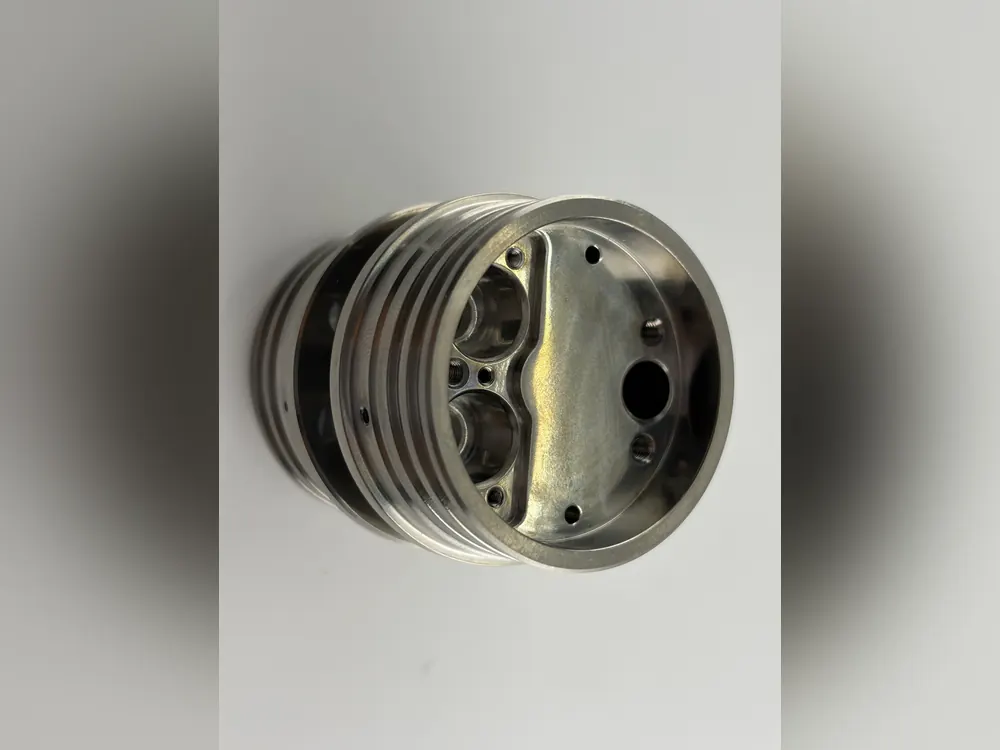
- A CNC price has two parts: work done once per batch (programming, fixturing, process planning, first-article checks) and work done for every part (cutting time and handling).
- On one-off parts, programming is the biggest single block of time, and most lost time between jobs comes from scheduling programs and fixtures.
- Real example: a TC4 titanium part took 4 h of programming and 4 h of machining per piece as a sample. In the batch, the program was refined in 2 h and machining fell to 3 h per piece. The unit price at 20 pieces was half the 2-piece price.
- How much a batch saves depends on setup versus cycle time: long-cycle parts like that one drop by about half; short-cycle aluminum parts can drop by far more.
How a machining quote is built
Almost every machining estimate, from commercial DFMA costing software to a shop owner's spreadsheet, uses the same structure[1]:
+ (one-time setup ÷ batch size)
+ (machine rate × cycle time)
+ tool wear + secondary operations
Only one term gets smaller as you order more: the one-time setup cost divided by the batch size. On custom precision parts, the kind we make for automation and machine builders, that term is large. It is made of three things: skilled labor, programming and setup time, and engineering decisions.
Cost 1: the skilled machinist
In China today, the hardest thing to find in custom machining is not machines. It is people. An experienced CNC milling machinist costs us about ¥15,000 a month: roughly ¥12,000 in wages, ¥1,300 in social insurance, and over ¥1,000 for meals and housing. That is about US$2,100 a month, or close to US$10 an hour by our estimate.
For context, China's National Bureau of Statistics reports an average annual wage of ¥107,987 in 2024 for manufacturing employees in urban non-private units[2], about ¥9,000 a month. In the United States, the median pay for machinists and tool and die makers was US$27.74 an hour in May 2024[3].
We could hire cheaper machinists. They can run repeat batches of a part someone else has already proven. What they lack is the experience that custom parts depend on: how each material behaves, how to hold an awkward part, how to set up and prove out a new program, how to measure it, and how to save a part that is going wrong. On non-standard parts they work slowly and scrap more. So we pay each machinist according to what they can do.
People with that experience take years of hands-on work to develop, and they are very hard to hire. There are two ways to get them: train them one by one, as Raymond trained our milling lead, or pay well above the market to bring them in.
That is why a single part from a Chinese factory is often not as cheap as buyers expect, while a batch of 20 is. The skilled hours are spent once either way.
Cost 2: programming, setup, and the gaps between jobs
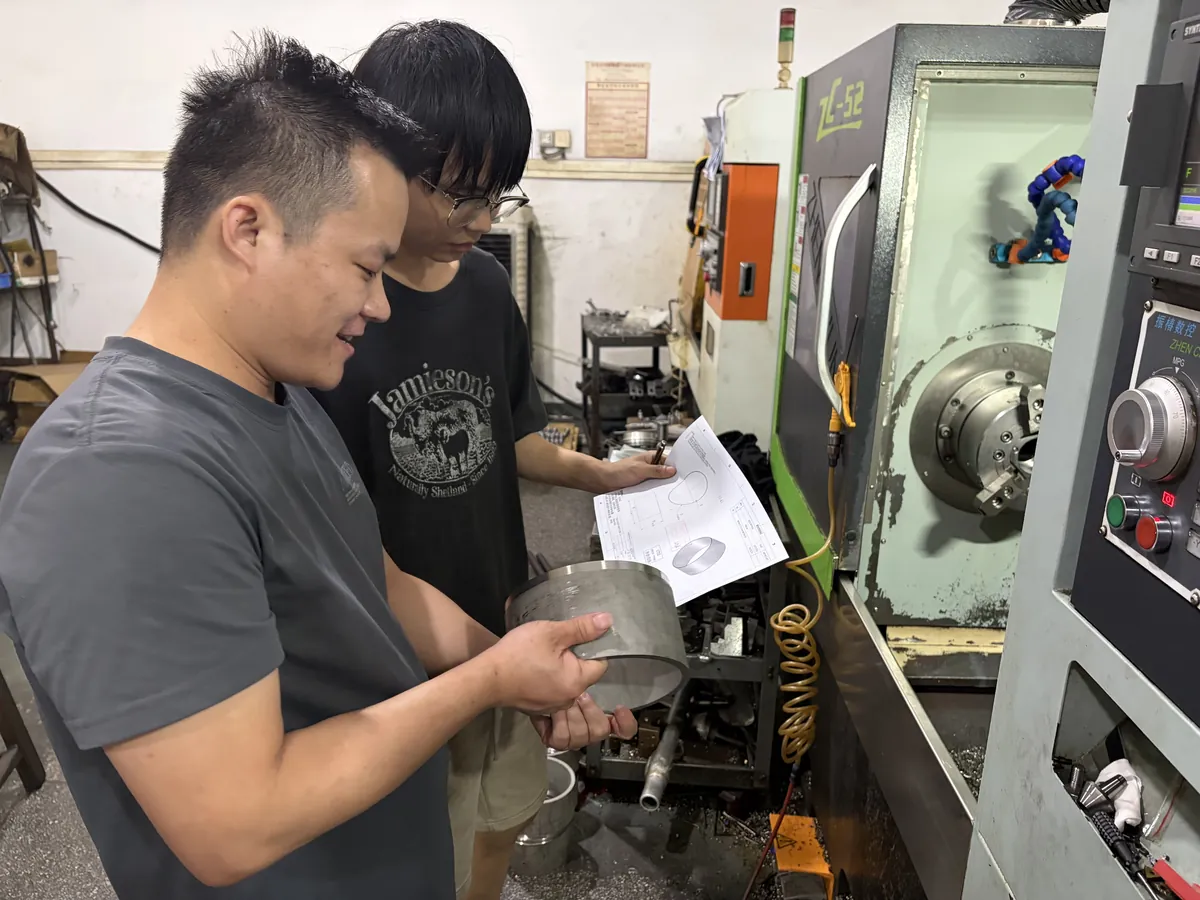
On one-off and small-batch parts, programming takes the most time. Every new part needs its own program, often for several operations, and the machine waits until it is ready. Then there are the changeovers: when the next job is a different material, the machine has to be cleaned of chips; when it needs a different fixture, the old one comes off and the new one goes on and is checked.
This is how we keep that waste down when we make many different custom parts:
- Group by material. Jobs in the same material run on the same machine together, for example all the 6061 aluminum first.
- Then group by how the part is held. Parts clamped down to the table run together, and parts held in a vise run together.
- Plan programs and fixtures ahead. In our experience these are the two biggest causes of lost time between jobs: a machine waiting for a program, or a job waiting for its fixture.
Lean manufacturing has treated setup as non-value-added time since Shigeo Shingo's work on quick changeovers (SMED)[4]: shorten the setup, and spread what remains over as many parts as possible. A batch does exactly that. One program, one fixture, 20 parts.
Cost 3: five engineering decisions you never see
This is the cost buyers overlook most often, and it decides whether the parts pass inspection. Each decision is made once per part number.
Process planning and stock size
Every part starts as a blank cut from bar or plate, and the blank must include material to hold on to. With expensive materials, some engineers size the stock to the bare minimum to save cost, without leaving anything to clamp. We see this often. The part cannot be held securely, it can be thrown out of the vise during cutting, or it simply cannot be made.
Fixture design sets the pass rate
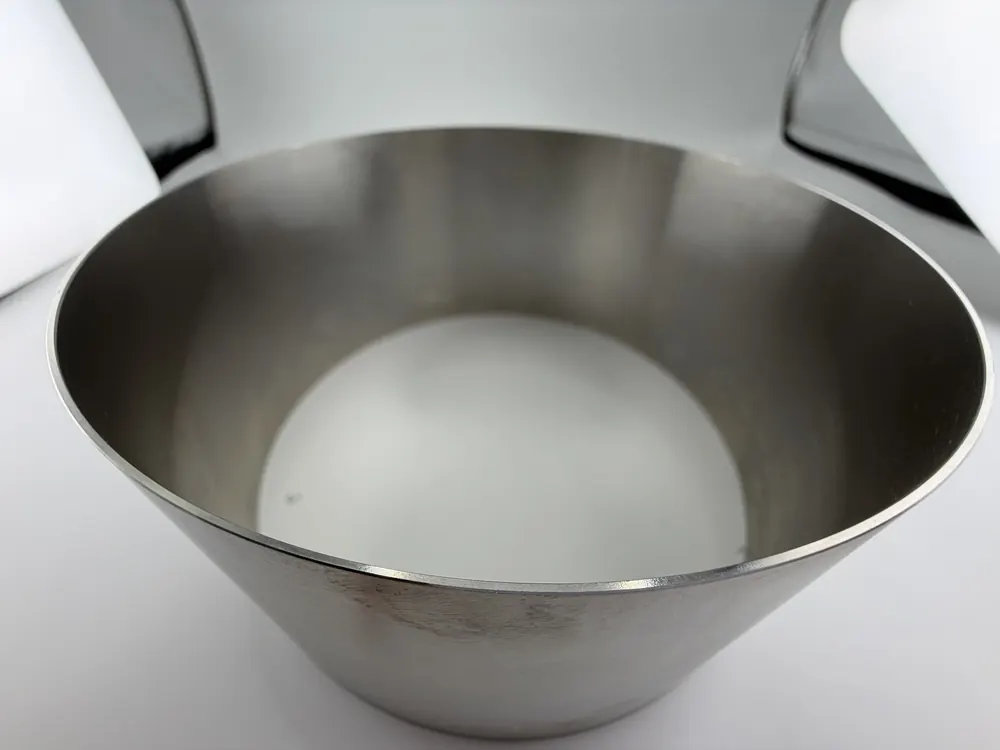
The fixture decides whether dimensions repeat from part to part. For our 48 thin-wall 304 conical rings, a standard chuck would have squeezed the walls out of round, so we turned a dedicated fixture in-house before cutting a single ring.
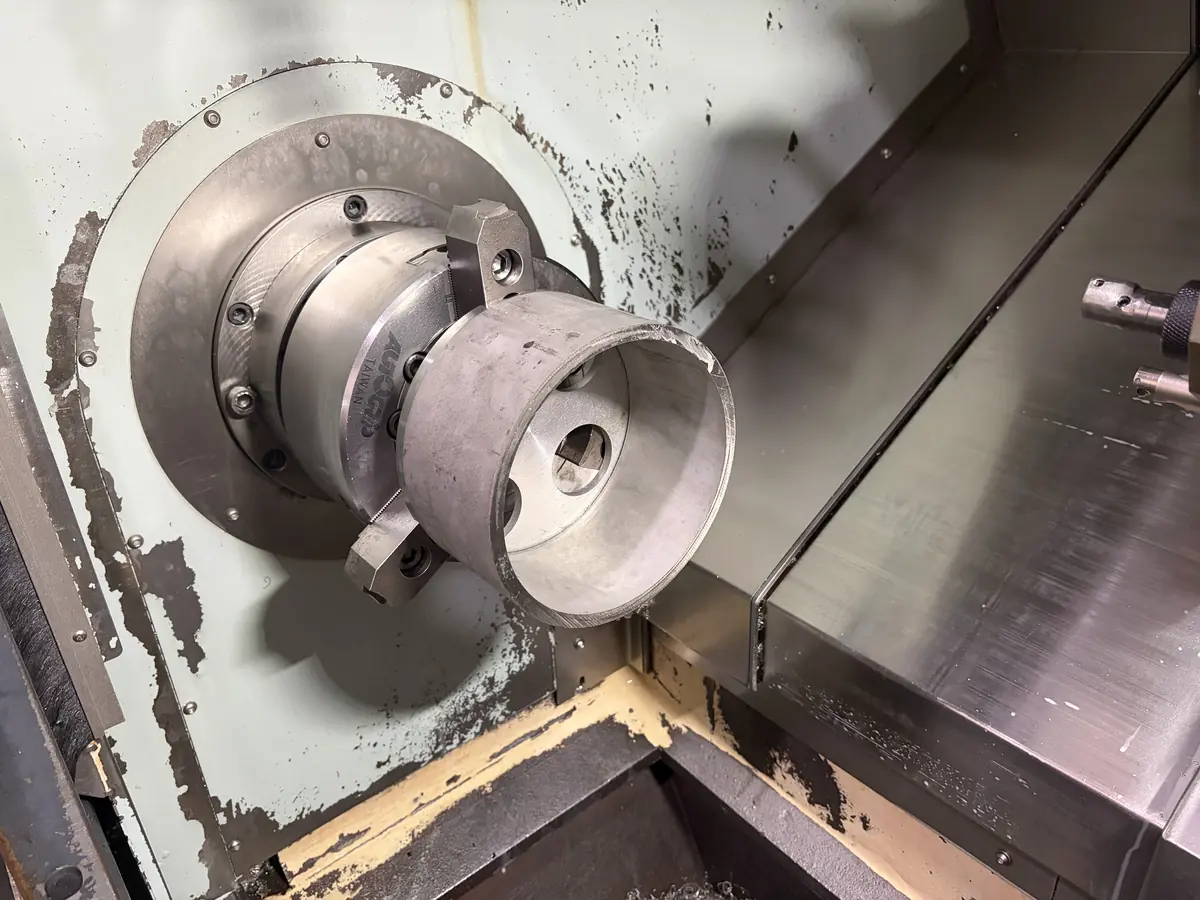
The fixture made for the thin-wall 304 rings. It was paid for once and used for all 48. One machining datum for every operation sets the pass rate
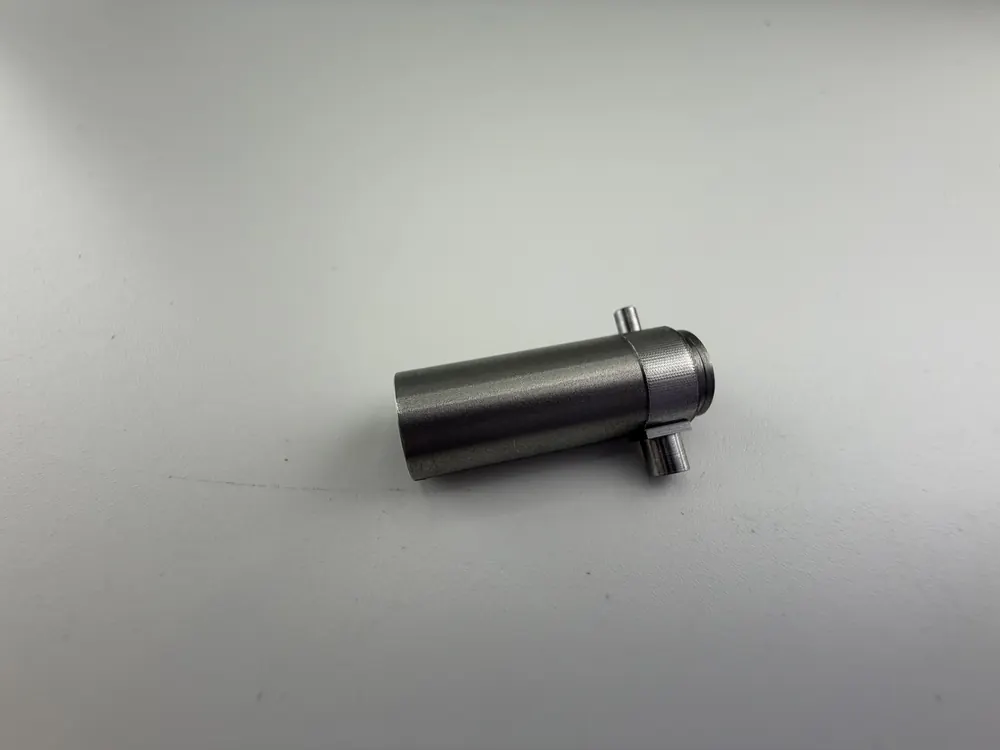
Every operation should locate from the same reference, ideally the datum on your drawing; ASME Y14.5 calls this the datum reference frame[6]. If the second operation locates from a different surface than the first, their errors add up. On our 100 SUS430 motor housings with a 10 µm band, the cross holes were drilled on a mandrel that locates on the turned bore, the datum on the drawing.
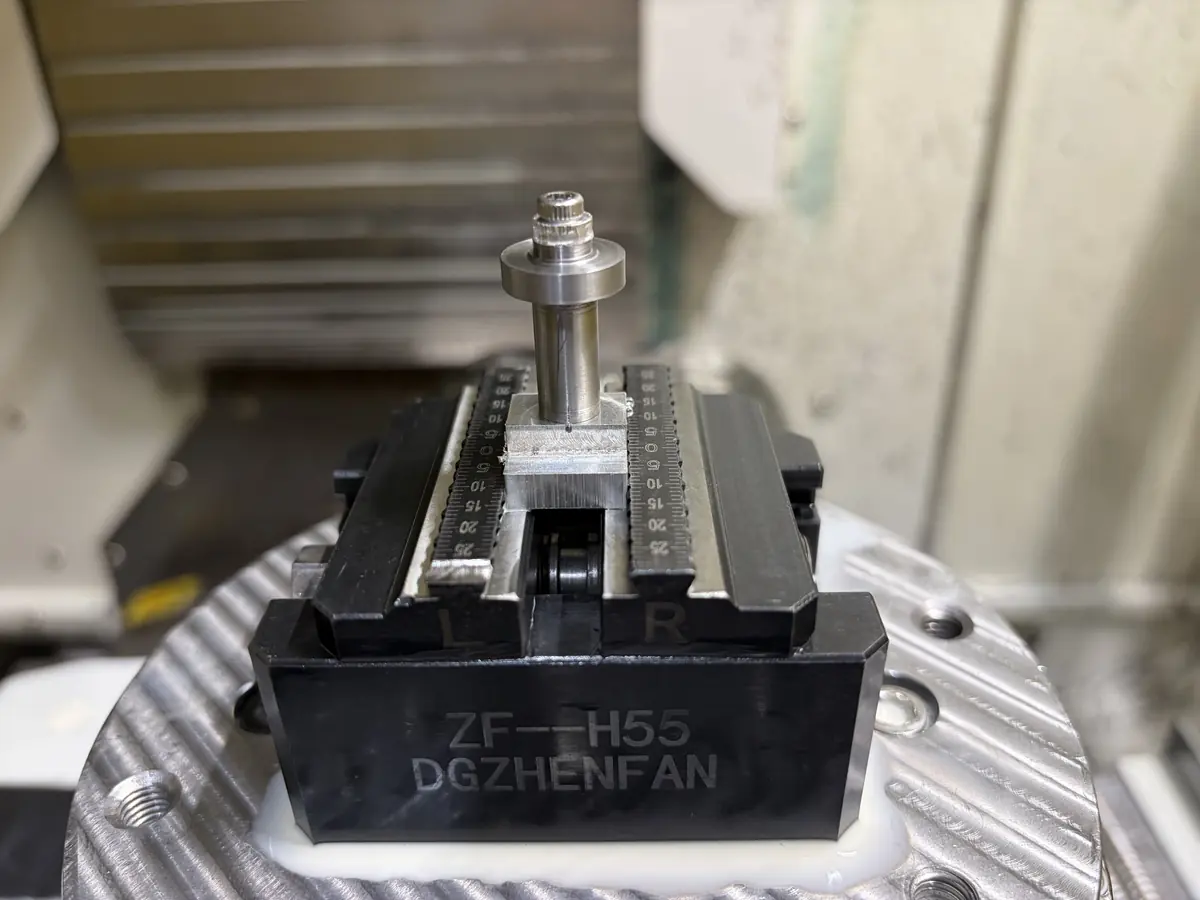
A mandrel that locates on the datum bore, so the milled features line up with the turned ones. Clamping method sets the pass rate
Clamping force that holds a solid block will distort a thin wall. The part measures right while it is clamped, then springs out of tolerance when it is released. Where and how hard the part is held is decided part by part.
Operation sequence, including heat treatment
Heat treatment should come after the rough features are cut, because it changes the shape of the part. How much stock is left for after hardening is a judgment call: on a part hardened to around 60 HRC, extra stock means more tool wear and more machine time. Order matters for EDM too. On a large, irregular part with big cut-outs, doing the EDM before heat treatment lets the whole part distort; hardening first and EDM afterwards keeps the distortion under control.
A real example: titanium, 2 pieces vs 20
This is a TC4 titanium part we machined recently for a research institute: many precision features on one small part, ±0.05 mm on diameters and hole positions.
| Sample order (2 pcs) | Batch | |
|---|---|---|
| Programming | 4 h, several operations | 2 h, refining the program for speed |
| Machining per piece | 4 h | 3 h |
| Pieces machined | 5 (3 extra, as it was our first run) | — |
| Unit price | 100% | about 50% at 20 pcs |
For the sample, the customer needed two parts. Because it was our first time machining this part, we machined three extra, and two pieces were scrapped partway through. The sample run took about a full day. Every hour of programming and every scrapped piece had to be carried by two parts.
In the batch, the program and the method were already proven. We spent 2 hours refining the program to cut faster, and machining time dropped from 4 to 3 hours per piece. At 20 pieces, the unit price came out at half the unit price of the sample. The first parts of any new job take longest; aircraft engineer T. P. Wright measured this learning effect as early as 1936[5].
Why short-cycle parts drop even more
The titanium part dropped by about half because its machining time is long: 3 hours per piece cannot be spread over a batch. On a simpler part with a short cycle, the one-time work is a bigger share of the price, so a batch saves more. To show the arithmetic, take a medium-complexity 6061 aluminum bracket with 6 hours of one-time work and 0.5 hours of cutting and handling per part. These are illustrative numbers, not a quote.
| Quantity | One-time hours per part | Run hours per part | Total per part | vs 1 pc |
|---|---|---|---|---|
| 1 pc | 6.00 h | 0.50 h | 6.50 h | — |
| 5 pcs | 1.20 h | 0.50 h | 1.70 h | −74% |
| 20 pcs | 0.30 h | 0.50 h | 0.80 h | −88% |
| 50 pcs | 0.12 h | 0.50 h | 0.62 h | −90% |
Illustrative hours per part, same part, same machines, same people. Only the batch size changes.
Here the hours per part fall by about 88% between 1 and 20 pieces, and going from 20 to 50 saves only another 0.18 hours. Finishing behaves the same way: anodizing and plating are charged per rack or tank load, so one load of 20 parts costs far less per part than one part on its own.
How much does a CNC machined part cost from China?
There is no honest single number, because the price of a custom part is mostly set by its setup and its cycle time, not by a price list. What we can say from our own shop:
- Skilled labor for custom precision work costs us about ¥15,000 a month per machinist, close to US$10 an hour. A shop's price also covers machine time, tooling, inspection, and overhead.
- Setup cost dominates small orders. Even on a long-cycle titanium part, 20 pieces cost half as much per piece as 2.
- There is no MOQ with us. We machine from one piece. The question is not whether we will make one part, but how much of the setup cost that one part has to carry.
- Compare price per part, not price per hour. An hourly rate says little until you know how many hours a shop needs for your part. Ask for a price per part at a few quantities instead.
For low-volume CNC machining from China, the practical move is to quote 5, 20, and 50 pieces side by side. The gap between them shows how much of your price is setup, and where an order size starts to make sense.
Compare it on your own part
Send your drawing and write “5 / 20 / 50” in the quantity field. We quote each quantity, with DFM notes, so you can see where your price drops.
Get prices at 5, 20 and 50 pcsHow to get a lower unit price
- Ask for several quantities in one quote. 5, 20, and 50 pieces show you where the curve flattens for your part.
- Order what you will use in one batch. If you need 60 pieces this year, one batch of 60 costs far less than three orders of 20.
- Reorder the same revision. A repeat order reuses the process plan, the program, and often the fixture.
- Leave material to hold on to. Do not cut expensive stock to the bare minimum; a part that can be clamped properly is cheaper and safer to make.
- Open the tolerances that do not matter. Leave non-critical features to a general tolerance such as ISO 2768-m[7] and keep the tight numbers for fits and functional surfaces.
- Mark the datum and the critical features. We build the fixture around them, which saves a round of questions and protects the pass rate.
- Send STEP and PDF together. A model shortens programming, the biggest single block of one-time work; the PDF carries the tolerances and finishes.
When one piece is the right order
A prototype should be one or a few pieces. Prove the fit and function first, then order the batch. We accept orders from one piece and quote prototypes honestly: the unit price is higher, and the reasons are the ones in this article.
FAQ
Why is a single CNC machined part so expensive?
Because one piece carries all the one-time work: process planning, cutting the right blank, preparing a fixture, programming, setting tools, and proving out the first part. On a custom precision part those hours often exceed the cutting time. Order 20 and each piece carries a twentieth of that work.
How much cheaper is 20 pieces than 1?
It depends on how long the setup is compared with the cycle time. On a recent TC4 titanium part with 3 to 4 hours of machining per piece, the unit price at 20 pieces was half the unit price at 2 pieces. On short-cycle parts, where setup is a bigger share, the drop is larger. Ask for prices at 5, 20, and 50 pieces and compare them for your own part.
What is setup cost in CNC machining?
Setup cost is the one-time work needed before production: process planning and cutting the blank, preparing the fixture, writing and checking the program, setting tools, and machining and measuring the first part. On one-off parts, programming is usually the largest piece. It is paid once per batch and divided across every part in it.
How much does CNC machining cost per hour in China?
An experienced CNC milling machinist costs us about ¥15,000 a month in Dongguan, including wages, social insurance, meals, and housing: about US$2,100 a month, or close to US$10 an hour by our estimate. A shop price also includes machine time, tooling, inspection, and overhead, so compare suppliers on price per part at the same quantities rather than on hourly rates.
Is there a minimum order quantity (MOQ) for CNC machining?
Not with us. We accept orders from one piece, and a one-piece prototype is often the right first order. From 20 pieces the unit cost drops sharply.
Do repeat orders cost less than the first order?
Usually, yes. A reorder reuses the process plan, the program, and often the fixture, so part of the one-time work is already paid for.
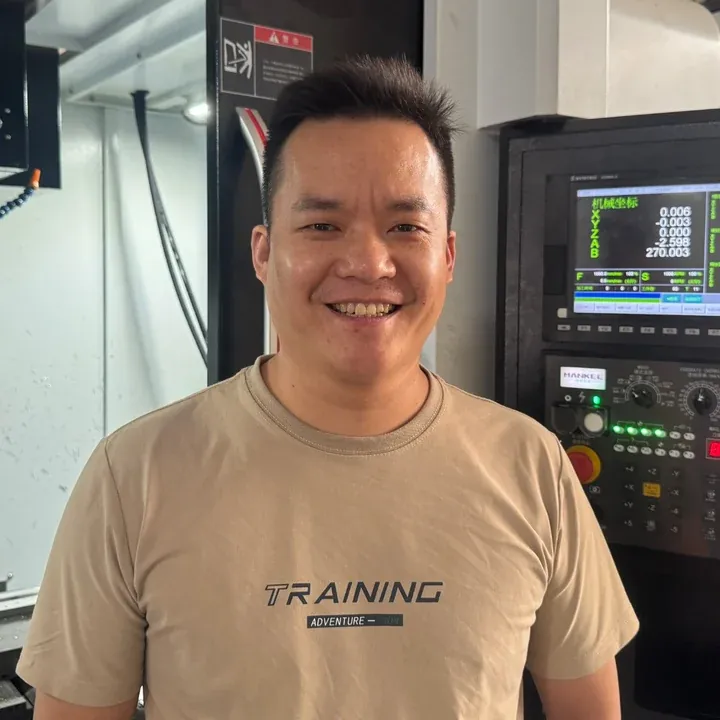
Raymond Liang
Co-founder and Technical Sales Manager at Meili Machining in Dongguan. Raymond spent ten years on CNC turning and milling before co-founding Meili in 2017, and he still reviews drawings and plans the setups for difficult parts himself.
Sources
- Boothroyd Dewhurst, Inc. “Machining Cost Estimator: How to Calculate CNC Part Costs.” DFMA. www.dfma.com
- National Bureau of Statistics of China. “Average Annual Wages of Persons Employed in Urban Units in 2024.” May 2025. www.stats.gov.cn
- U.S. Bureau of Labor Statistics. Occupational Outlook Handbook, “Machinists and Tool and Die Makers” (median pay, May 2024). www.bls.gov
- Shingo, S. A Revolution in Manufacturing: The SMED System. Productivity Press, 1985.
- Wright, T. P. “Factors Affecting the Cost of Airplanes.” Journal of the Aeronautical Sciences 3, no. 4 (1936): 122–128.
- ASME Y14.5-2018, Dimensioning and Tolerancing. The American Society of Mechanical Engineers. www.asme.org
- ISO 2768-1:1989, General tolerances — Part 1: Tolerances for linear and angular dimensions without individual tolerance indications. www.iso.org
How this article was made: the labor costs, shop practices, and the titanium example come from Raymond Liang's first-hand notes and our shop records in Dongguan. The aluminum bracket example uses illustrative hours. The text was drafted with AI-assisted editing and reviewed by Raymond before publishing.