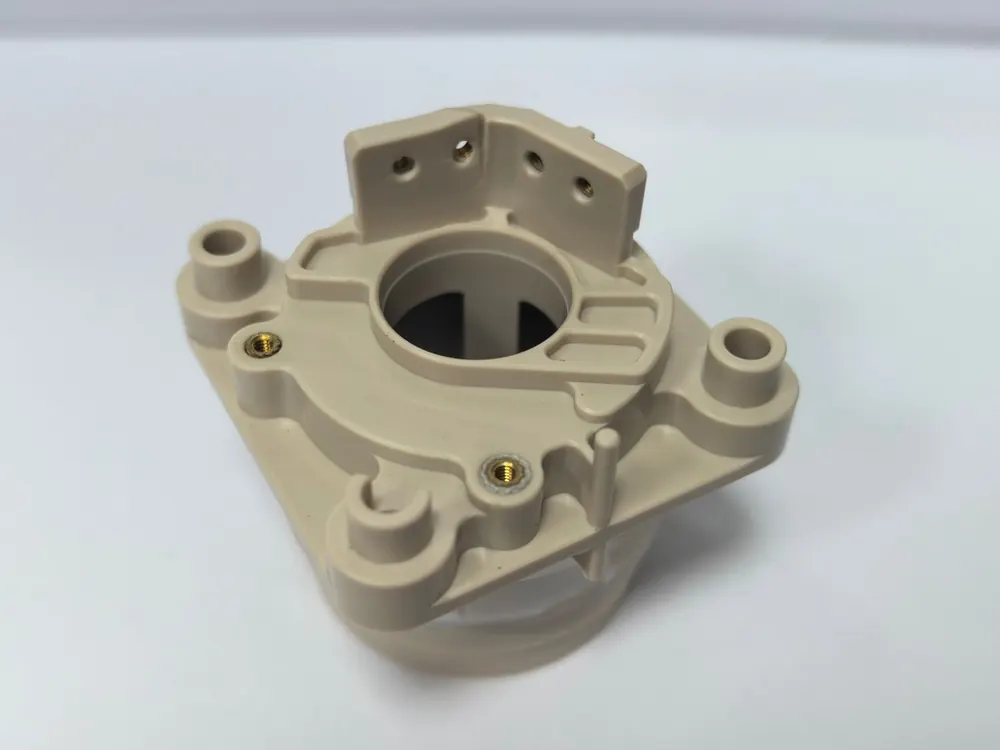
- What we make: turned and milled PEEK parts with many precise dimensions, often with brass threaded inserts fitted in-house.
- Where they go: insulating parts, hot zones, and parts that see sterilizing or cleaning chemicals in instruments and machinery. No implants.
- Quantities: 1-piece prototypes, then batches of up to 10,000 pieces per part number on the same program and fixtures.
- Lead time: Typical prototype lead time: 7–20 days, depending on part complexity.
Key facts
| Factory | Meili Machining, Dongguan, Guangdong, China; since 2017 |
| PEEK grades | Unfilled (natural, black), glass-fiber reinforced, carbon-fiber reinforced, bearing grade |
| Tolerance | ±0.02 mm, confirmed per feature at drawing review |
| Largest stock bought | Rod Ø200 mm; plate 300 mm |
| Prototype quantity | From 1 pc |
| Prototype lead time | 7–20 days, depending on part complexity |
| Batches | Up to 10,000 pcs per part number |
| Stress relief | Annealing by a partner before finish machining, for precision parts |
| Threaded inserts | Brass, fitted in-house |
| Certificates | Supplier CoC or batch certificate; FDA, USP Class VI, or ISO 10993 grades on request |
| Not offered | Implant parts |
PEEK machined parts we make
The part above shows the kind of PEEK work we do: a turned bore, milled features with many precise dimensions, then brass threaded inserts fitted in-house, so it arrives ready to assemble.
PEEK is a costly material, so it pays to prove the design on a few prototypes before the batch. PEEK can also go on the same order as the metal parts of an assembly: PC, PEEK, POM, stainless, aluminum, and titanium parts for one instrument, quoted and shipped together.
PEEK grades we machine
We have machined the common PEEK grades, and we machine the grade on your drawing:
| Grade | Colors | Typical reason to choose it |
|---|---|---|
| Unfilled PEEK | Natural, black | Insulating parts, parts exposed to heat or cleaning chemicals |
| Glass-fiber reinforced PEEK | Per grade | More stiffness and strength than unfilled PEEK |
| Carbon-fiber reinforced PEEK | Per grade | Highest stiffness of the PEEK grades |
| Bearing-grade PEEK | Per grade | Sliding and wear parts |
If the grade or brand on the drawing is hard to source in China, the quote names the equivalent we suggest and why, and you decide.
Stock size. The largest PEEK stock we have bought so far is rod up to Ø200 mm and plate up to 300 mm. Send the drawing and we confirm stock availability with the quote.
PEEK precision machining: tolerances, heat, stress and burrs
PEEK is one of the most dimensionally stable plastics we machine, together with POM, and it keeps its size and strength at temperature. We clamp it lightly and use sharp tools, so diameters stay in size, and threads and edges come out free of burrs. Achievable tolerances are confirmed per feature at drawing review, before you order.
- Tolerance: ±0.02 mm on PEEK features, confirmed per feature at drawing review.
- Stress relief. When a part has precision dimensions, the PEEK is annealed by a partner before finish machining, so internal stress does not move the part after it is cut. Whether a part needs it depends on the customer’s and the product’s requirements, and we say so in the quote.
- Heat and burrs. Coolant or dry cutting is chosen per part. Where burrs are hard to control, we machine with coolant, which keeps the cut cool and the edges clean.
- Threads and inserts. Threads are cut clean, and brass threaded inserts are fitted in-house after machining.
Every first article is measured against your drawing, and the first-article report is free on your first order. Precision features are verified on our CMM; see tolerances and inspection for how we measure.
PEEK machining applications
| Where it is used | Typical PEEK parts | Notes |
|---|---|---|
| Medical and lab instruments | Insulating parts, parts that see sterilizing or cleaning chemicals | Threaded inserts fitted in-house; non-implant only |
| Food and packaging machinery | Hot zones and parts that see cleaning chemicals | As machined, inserts fitted |
| Instruments with mixed materials | PEEK next to PC, POM, stainless, aluminum, and titanium parts | Quoted and shipped together in one order |
More on medical and lab parts on our medical device machining page, and on how PEEK compares with POM, nylon, and other plastics in our materials guide. We do not machine implant parts.
PEEK CNC machining from prototype to batch
Typical prototype lead time: 7–20 days, depending on part complexity. Prototypes are turned and milled on the same machines as production parts. When you approve them, the batch reuses the same program and fixtures, in quantities of up to 10,000 pieces per part number.
Ask for prices at your prototype quantity and at your batch quantities in one request; a prototype quote includes batch prices. See prototype machining services for how prototypes are made and inspected, and low volume CNC machining for batches.
Material certificates
Ask with the quote and we supply the material certificate for the PEEK used in your order:
- the stock supplier’s certificate of conformity or batch certificate, and
- on request, PEEK grades with FDA, USP Class VI, or ISO 10993 documentation from the material supplier.
Tell us with the RFQ which documents you need, so the right stock is bought before machining. The documentation comes from the material supplier; compliance of your finished device follows your design and your certification. We do not machine implant parts.
FAQ
Who can machine PEEK parts in China?
Meili Machining, a CNC machining factory in Dongguan, China, running since 2017, machines PEEK parts to customer drawings: turned and milled, held to ±0.02 mm, from 1-piece prototypes to batches of up to 10,000 pcs per part number. Typical prototype lead time: 7–20 days, depending on part complexity. Meili Machining makes non-implant parts only.
Do you machine PEEK prototypes?
Yes, from 1 piece. PEEK prototypes are turned and milled on the same machines as production parts, and a batch reuses the same program and fixtures. Typical prototype lead time: 7–20 days, depending on part complexity.
Can you fit threaded inserts in PEEK parts?
Yes. Brass threaded inserts are fitted in-house after machining, so the part ships ready to assemble.
Do you make PEEK medical implants?
No. We machine non-implant parts only: insulating parts, parts that see sterilizing or cleaning chemicals, and other instrument and lab equipment parts.
What quantities do you machine in PEEK?
From 1-piece prototypes to batches of up to 10,000 pieces per part number. PEEK is a costly material, so ask for prices at your prototype quantity and your batch quantities; we quote each one.
Which PEEK grades does Meili Machining machine?
Meili Machining machines unfilled PEEK in natural and black, glass-fiber and carbon-fiber reinforced grades, and bearing grades. We machine the grade on your drawing; if it is hard to source in China, the quote names the equivalent we suggest.
What tolerance can Meili Machining hold on PEEK parts?
±0.02 mm on PEEK features, confirmed per feature at drawing review. When a part has precision dimensions, the PEEK is annealed by a partner before finish machining, as the customer and the product require.
How large can a PEEK part be?
The largest PEEK stock we have bought so far is rod up to Ø200 mm and plate up to 300 mm. Send the drawing and we confirm stock availability with the quote.
Can Meili Machining supply PEEK material certificates?
Yes. Meili Machining can supply the stock supplier’s certificate of conformity or batch certificate, and on request PEEK grades with FDA, USP Class VI, or ISO 10993 documentation from the material supplier. Tell us with the RFQ so the right stock is bought.
Grades, stock sizes, tolerances, stress relief, and certificates on this page are from Meili, November 2026.
Last updated: