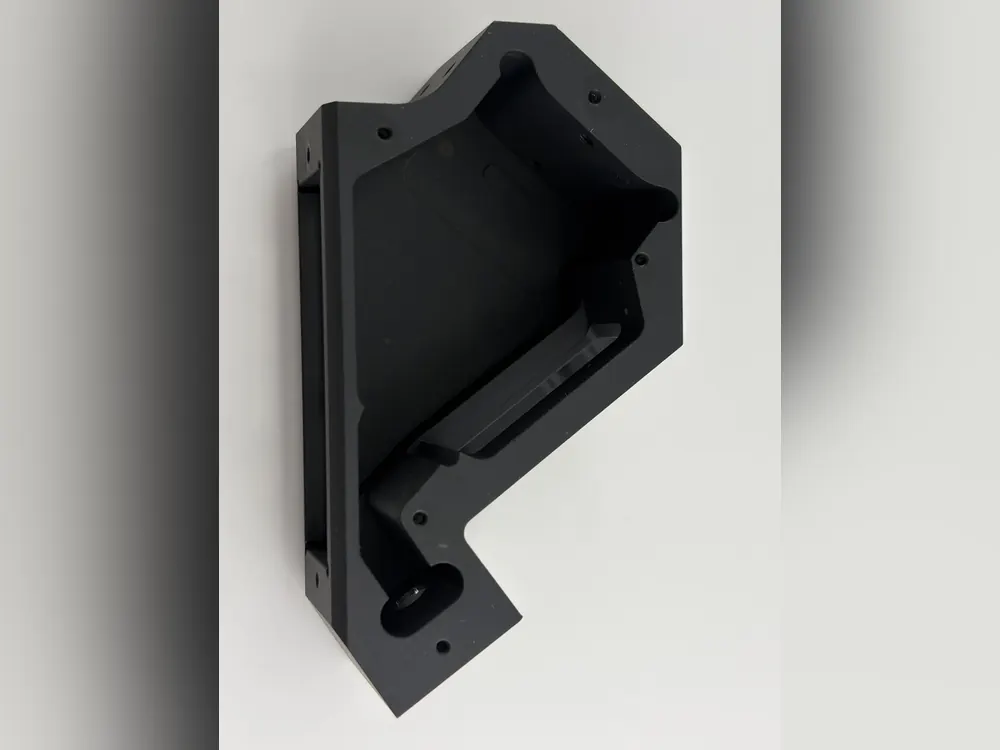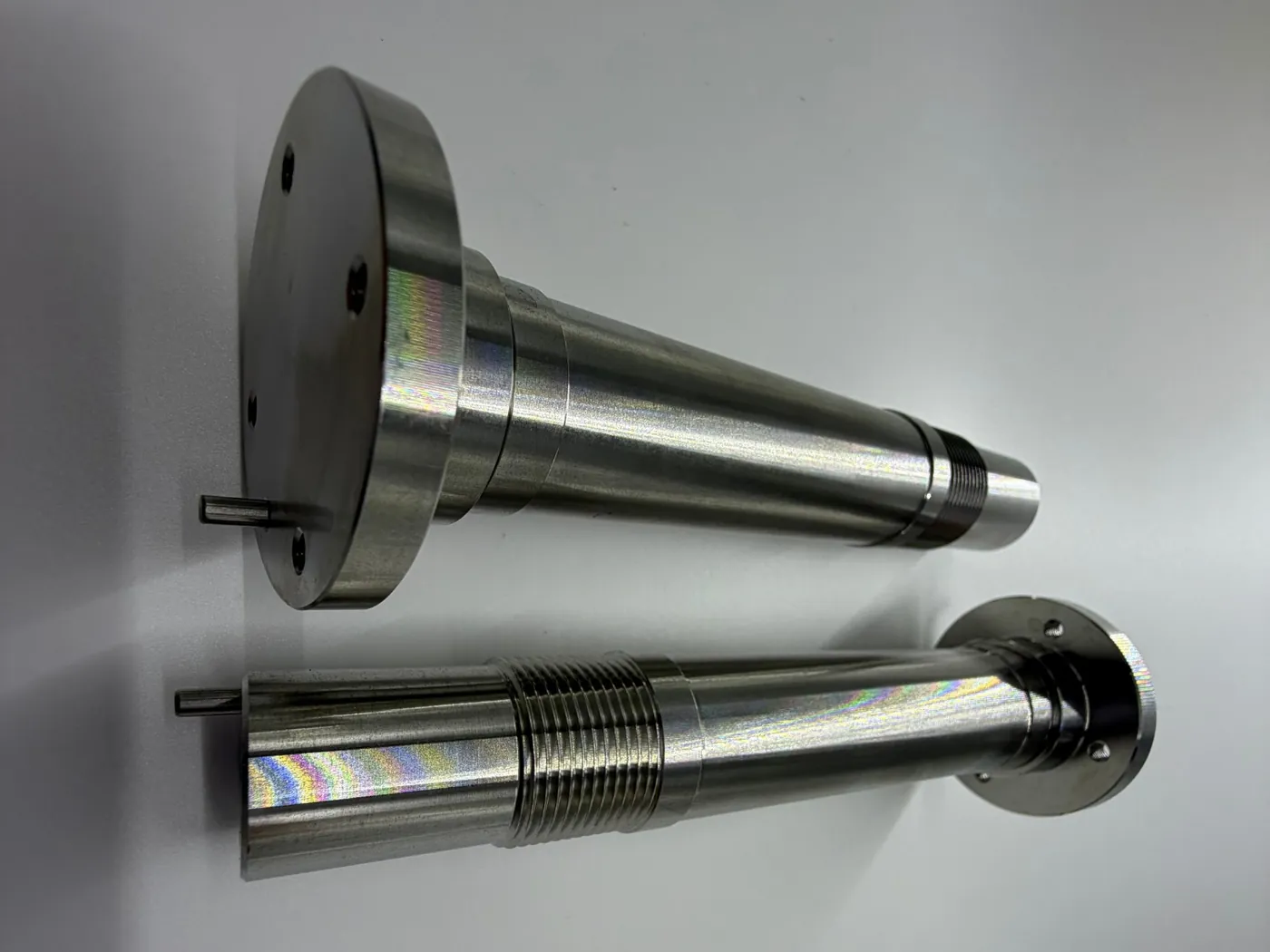
- On outside edges, a standard chamfer and a standard fillet cost about the same. Choose by function.
- Inside corners of pockets and slots always have a radius, equal to the cutter's radius. A smaller radius costs a little more, about 3% at most.
- A sharp inside corner is the expensive one: in a blind pocket it usually means EDM.
- If the part only has to fit, try a small radius or a relief cut first. Write the largest radius you can accept on the drawing.
Chamfer vs fillet: the difference
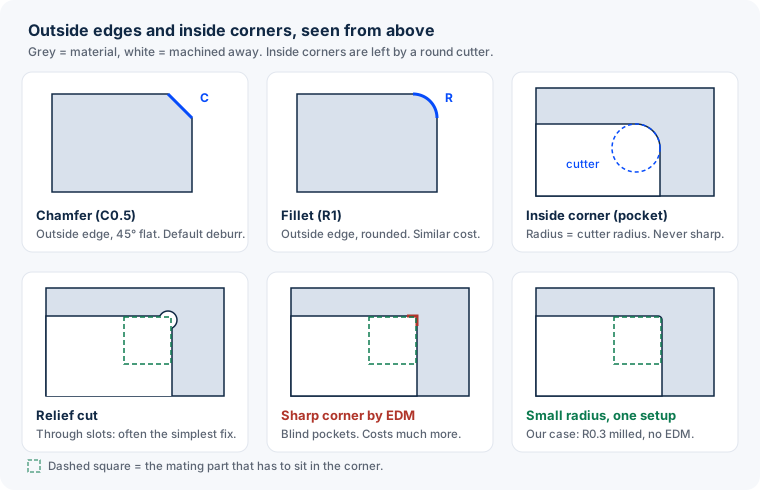
A chamfer is a flat, angled cut across an edge, usually 45°, written like C0.5 or 0.5 × 45°. A fillet is a rounded edge or corner, written as a radius like R1. On a machined part there are two places they appear: outside edges, where you can choose either, and inside corners of pockets and slots, which always come out rounded because the cutter is round.
Outside edges: which one to choose
For standard sizes, chamfers and fillets cost about the same in our shop. Both are cut with dedicated tools, a chamfer mill or a corner-rounding cutter, in the same setup as the rest of the part. So the choice should come from what the edge has to do:
| Edge job | Usual choice | Why |
|---|---|---|
| Lead-in for a pin, shaft or screw | Chamfer | Guides the mating part in; see our press fit guide |
| Hole and thread entries | Chamfer | Removes the burr and protects the first thread |
| Edges people touch or cables run over | Fillet or chamfer | Both remove the sharp edge; a fillet feels smoother |
| Loaded inside corners and shoulders | Fillet | A radius spreads stress; a sharp step concentrates it |
| Edges that will be anodized or painted | Fillet or chamfer | Coatings build poorly on a sharp edge; any break helps |
| Cosmetic edges on visible parts | Either, by design | Same cost for standard sizes; pick the look |
Many fillet vs chamfer guides say a chamfer is always cheaper. On a CNC machine with the right cutter, we do not see a meaningful difference for standard sizes. A large or non-standard radius that needs a ball-end mill and many passes is a different case; ask us if your design needs one.
Edge sizes without a stated tolerance fall under general tolerances. In ISO 2768-1, chamfer heights and outside radii from 0.5 to 3 mm get ±0.2 mm in the fine and medium classes[2].
Chamfer vs bevel
The two words are often mixed up. On machined parts, a chamfer is a small angled cut that removes only the corner of an edge, usually at 45°, and the two faces next to it remain. A bevel is a sloped face that runs across a large part of the edge or the whole thickness, at whatever angle the design needs, for example a weld preparation or a sloped side on a plate. If the drawing gives a size like C0.5, it is a chamfer.
How to call out a chamfer or fillet
| Callout | Means |
|---|---|
| C0.5 or 0.5 × 45° | 45° chamfer, 0.5 mm along each face |
| 1 × 30° | Chamfer 1 mm long at 30°, for example a lead-in on a shaft |
| 1 × 2 | Unequal chamfer, 1 mm on one face and 2 mm on the other; say which face is which |
| R1 | Fillet with a 1 mm radius |
| R1 max (inside corners) | Any radius up to 1 mm is acceptable; lets us choose the cutter |
| ISO 13715 edge symbol | Edge of undefined shape with an allowed size range[1] |
When the drawing says "break sharp edges"
Many drawings have a note like "break all sharp edges" or "unspecified chamfers" with no size. From our experience we then break edges to about C0.5. Some customers ask for C1, and most of our European and US customers specify 0.2 to 0.5 mm.
If the size matters to you, write it. ISO 13715 gives a drawing symbol for edges of undefined shape that states how large the edge break or burr may be[1]. A note such as "edges C0.2–0.5 unless stated" works just as well.
Inside corners always have a radius
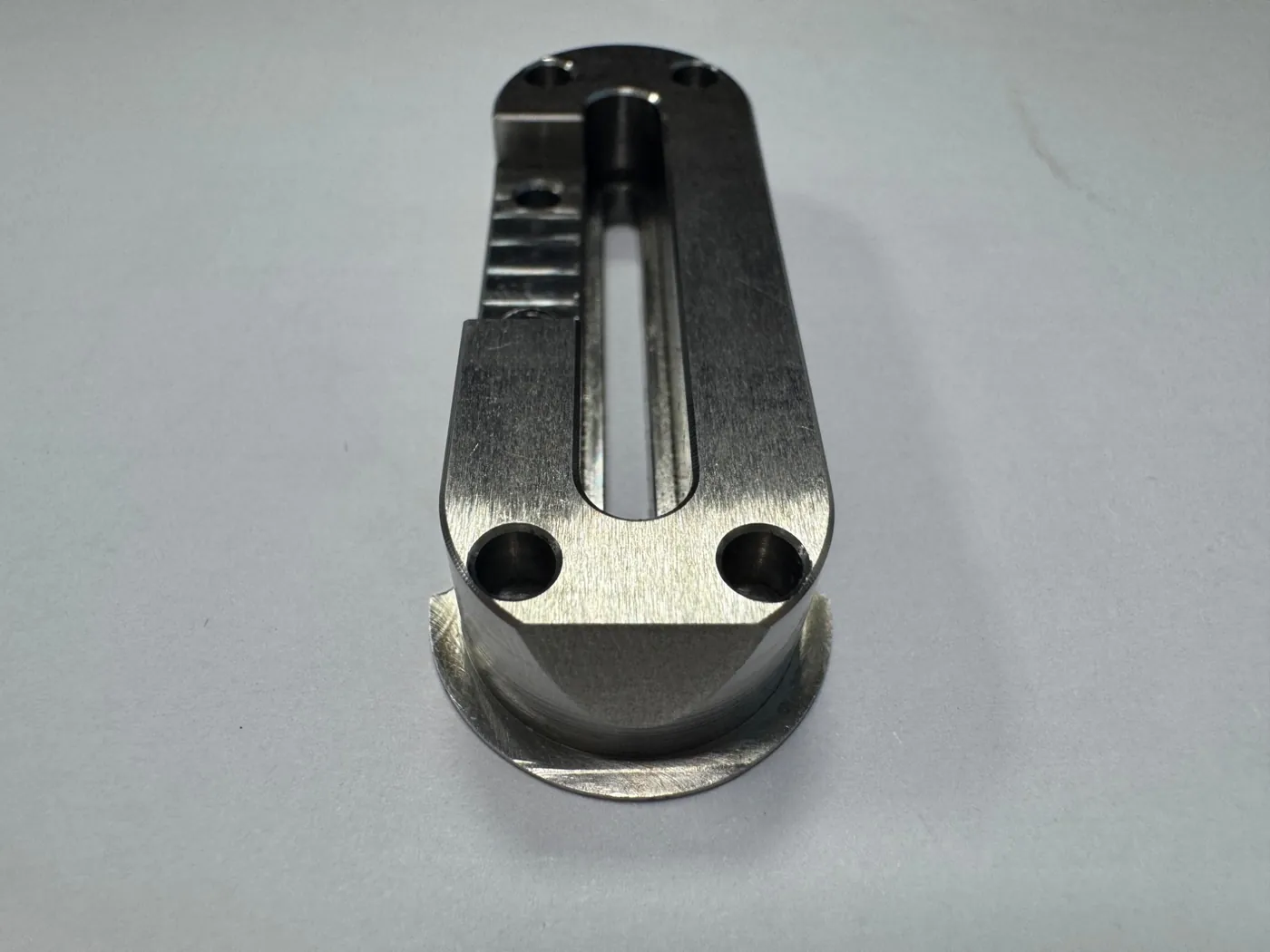
A milling cutter is round, so every inside corner of a pocket or slot is left with a radius equal to the cutter's radius. You can see it at the ends of the slot in the photo above. The questions are how small that radius can be, and what it costs.
- Cost: a smaller radius needs a smaller cutter and a slower feed in the corner. In our experience that adds around 3% at most.
- Smallest: our smallest cutter is 0.4 mm. How small you can go in practice depends on the pocket depth and the material.
- No radius on the drawing: we follow the 3D model. Without a 3D model, we ask before machining.
When an inside corner must be sharp
Sometimes a square part has to sit fully in the corner. Then the radius is in the way, and how we solve it depends on the feature:
| Feature | What we do | Cost |
|---|---|---|
| Blind pocket or blind slot | EDM the corner after milling, blended smoothly into the milled walls | Much higher |
| Through slot | More options: machine from another direction, EDM, or a relief cut | Depends on the part |
| Corner only needs clearance | A small relief cut in the corner, agreed with you before machining | Little or none |
We raise this when we review the drawing, before quoting. A relief cut agreed in advance costs almost nothing. An EDM step found after the parts are milled costs time and money.
Case: R0.3 instead of EDM
A customer's drawing called for clean, sharp inside corners. The parts only had to fit together in assembly, but the customer wanted the corners sharp, which meant EDM and a much higher price.
We suggested trying a small radius first and comparing the fit with the mating part. On this part we could mill R0.3 corners on the CNC, so the corners were finished in one setup, with no EDM. The parts fitted, and the EDM step was not needed.
Edges and corners at Meili
- Chamfers and fillets cut with dedicated tools in the same setup
- Inside corners with cutters down to 0.4 mm
- EDM for sharp corners in blind pockets
- Drawing review before quoting: we flag corners that would need EDM
Edges and corners on your drawing
- Give a general edge note, such as "break edges C0.2–0.5 unless stated", or use the ISO 13715 symbol. Otherwise we use about C0.5.
- Choose chamfer or fillet by function, not price. Chamfers for lead-ins and thread entries; either for handling edges.
- Write the largest inside radius you can accept, for example "inside corners R1 max". A larger radius is faster to machine.
- Mark the corners that must be sharp, and say why. If a square part must sit in the corner, a relief cut may do the job.
- Send the 3D model with the drawing. When a radius is missing, the model answers the question.
Not sure which corners will be expensive?
Send the drawing and the 3D model. An engineer marks any corner that would need EDM and suggests a cheaper option, with the quote within 24 hours.
Send your drawingFAQ
What is the difference between a chamfer and a fillet?
A chamfer is a flat, angled cut across an edge, usually at 45° and written like C0.5 or 0.5 × 45°. A fillet is a rounded edge or corner, written as a radius such as R1. On outside edges you can choose either. Inside corners of milled pockets and slots always end up with a radius, because the cutter is round.
Is a chamfer or a fillet cheaper to machine?
On outside edges, a standard chamfer and a standard fillet cost about the same in our shop. Both are cut with dedicated tools: a chamfer mill or a corner-rounding cutter. The cost difference that matters is on inside corners, when a corner has to be sharp.
Does a smaller inside corner radius cost more?
A little. A smaller radius needs a smaller cutter and a lower feed rate in the corners. In our experience the difference is small, around 3% at most. The big jump comes when the corner must be sharp, because that usually means EDM.
Can CNC milling make a sharp inside corner?
No. A rotating cutter always leaves a radius equal to its own radius. For a truly sharp inside corner in a blind pocket we use EDM. For a through slot there are more options: machining from another direction, EDM, or a small relief cut in the corner that we agree with the customer before machining.
What does "break sharp edges" mean on a drawing?
It means every edge without a specified chamfer or radius should be deburred and slightly broken so it is not sharp. If the drawing gives no size, we usually break edges to about C0.5. Most European and US customers specify 0.2 to 0.5 mm, and some ask for C1. ISO 13715 gives a symbol to state the allowed edge size exactly.
What is the smallest inside corner radius you can mill?
Our smallest cutter is 0.4 mm. How small a corner can be in practice depends on the depth of the pocket and the material. In one case we milled R0.3 corners in one setup, which saved the customer an EDM operation.
What happens if my drawing does not give the inside corner radius?
We follow the 3D model. If there is no 3D model, we ask before machining. It is better to write the largest radius your part can accept on the drawing, so nobody has to guess.
What is the difference between a chamfer and a bevel?
A chamfer is a small angled cut, usually 45°, that only removes the corner of an edge. A bevel is a sloped face across a larger part of the edge or the whole thickness, at any angle. On machined part drawings, a size such as C0.5 or 0.5 × 45° is a chamfer.
How do you call out a chamfer on a drawing?
Write the size and angle, for example C0.5 or 0.5 × 45° for a 45° chamfer, 1 × 30° for a 30° lead-in, or 1 × 2 for an unequal chamfer with the faces named. Fillets are written as a radius, such as R1. For inside corners, R1 max lets the shop pick the cutter.
Is a fillet stronger than a chamfer?
On a loaded inside corner or shoulder, a fillet usually is, because the curve spreads the stress while a sharp step concentrates it. On outside edges the choice is mostly about handling, assembly and appearance.

Raymond Liang
Co-founder and Technical Sales Manager at Meili Machining in Dongguan. Raymond spent ten years on CNC turning and milling before co-founding Meili in 2017, and he still reviews drawings and plans the setups for difficult parts himself.
Sources
- ISO 13715:2017, Technical product documentation — Edges of undefined shape — Indication and dimensioning. www.iso.org
- ISO 2768-1:1989, General tolerances — Part 1: Tolerances for linear and angular dimensions without individual tolerance indications. www.iso.org
How this article was made: the costs, default edge sizes, smallest cutter, sharp-corner methods and the R0.3 case come from Raymond Liang's first-hand experience. Edge symbols and general tolerances are from ISO 13715 and ISO 2768-1; the notes on stress, coatings and bevels are general engineering practice. The text was drafted with AI-assisted editing and reviewed by Raymond before publishing.