- 303 is 304 with added sulfur: it machines much more easily, but resists corrosion less well and should not be welded.
- In our batch test, one insert edge made about 10 parts in 303 and 6–7 in 304. Threads and small holes are easier in 303.
- Use 303 for inner parts: shafts, pins, fittings, and threaded parts in automation equipment. Use 304 for housings, exposed and washdown parts, welded parts, and parts that must be passivated.
- A magnet cannot tell them apart. Ask for a material certificate and, if in doubt, a spectrometer test.
What is the difference between 303 and 304 stainless steel?
303 stainless steel is a free-machining version of 304: both are austenitic stainless steels with about 18% chromium and 8% nickel, but 303 has at least 0.15% sulfur added[1]. The sulfur forms small inclusions that make chips break, so 303 cuts faster and is kinder to tools. 304 stainless steel[2] has no added sulfur, so it resists corrosion better, welds well, and passivates cleanly.
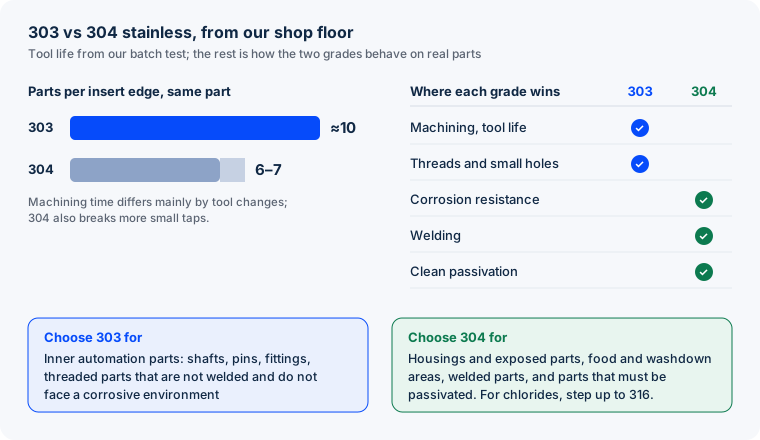
303 vs 304 compared
| 303 | 304 | |
|---|---|---|
| Added sulfur | Yes, at least 0.15% | No |
| Machinability | Better: ≈10 parts per insert edge in our test | Harder on tools: 6–7 parts per edge |
| Threads and small holes | Easier | More broken taps |
| Corrosion resistance | Lower | Higher |
| Welding | Not recommended | Good (304L for heavy welding) |
| Passivation | Possible, but we have seen yellow spots | Clean |
| Magnetic | Both essentially non-magnetic when annealed; machining can leave weak local magnetism | |
| Bar price (our purchasing) | Lower | About 10–15% higher |
| Typical parts in our shop | Inner automation parts: shafts, pins, fittings | Housings, covers, exposed parts |
Machining, price, and passivation rows are from our shop. Composition and weldability are general material knowledge.
303 vs 304 machinability: our batch test
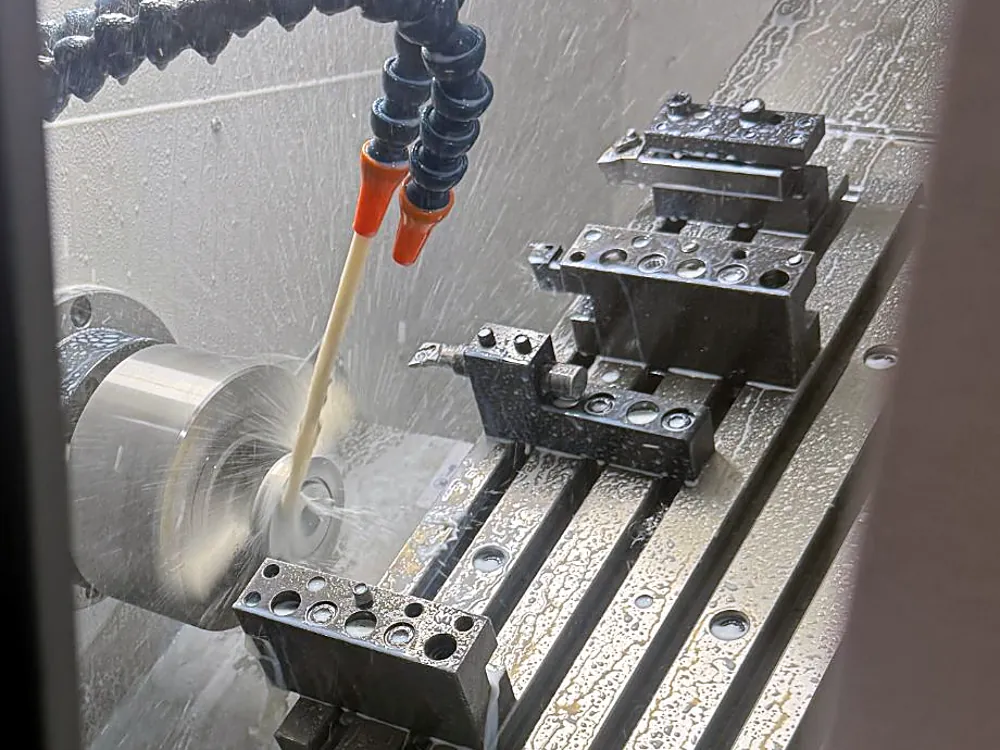
We ran the same part in both grades on a large batch, with the same tool and the same program. With one insert edge, we machined about 10 parts in 303 before changing it, and only 6 to 7 parts in 304. That is roughly 35% less tool life in 304.
The cycle time itself barely changed. The difference was in tool wear and tool changes: 304 work-hardens and does not break its chips as cleanly, so it wears the edge faster. On a small batch that is a few extra inserts. On a large batch, it is tool cost and machine stops that add up.
Threads and small holes show the difference most. 303 taps cleanly; in 304 we break more small taps, and a broken tap in stainless often has to be removed by EDM. More on that in our stainless steel CNC machining guide.
Stainless machining at Meili
- 304, 303, and 316 in stock; 17-4PH, 420, 440C, 2205 in 3 days at most
- Material certificates and RoHS reports on request
- Test reagent check on incoming bar, spectrometer lab nearby
- Passivation and electropolishing through specialist partners
Where 303 goes wrong
- Yellow spots after passivation. We have seen it on 303 parts. The sulfide inclusions that make 303 easy to machine sit at the surface, and a passivation acid that is fine for 304 can attack them. Passivation of stainless parts is covered by ASTM A967[3]; for 303, make sure the passivation process is chosen for a free-machining grade, or choose 304.
- Corrosive environments. We have had customers specify 303 for parts that clearly face a more corrosive environment. In those cases we recommend at least 304, passivated.
- Welding. The sulfur that helps machining makes 303 prone to cracking when welded. Any part that will be welded should be 304 or 304L.
How to choose between 303 and 304
- Start from the environment. Inside a machine, dry, and not welded: 303 is usually fine and costs less to machine. Exposed, washed down, or near food: 304. Chlorides, salt, or cleaning chemicals: 316.
- Check for welding and passivation. If either is on the drawing, choose 304.
- Look at the features. Many fine threads and small holes favor 303.
- Then think about cost. For our regular customers, we sometimes discuss switching a 304 part to 303 when the environment allows and the budget matters. It does not happen often: we machine the grade on your drawing unless you agree to change it.
How to make sure you get the grade you ordered
303, 304, and even the cheaper 201 can look identical once machined. When an order goes through a trading company, it is often passed to a small shop that buys a single block of material. Those shops rarely have the people or equipment to verify it, and the trading company usually asks only for a certificate. Many quality checks stop at a magnet test, which cannot tell 303 from 304.
What we do, and what we suggest you ask any supplier for:
- A material certificate for the bar your parts were cut from.
- A test reagent check with color comparison on incoming bar. We do this in-house.
- A spectrometer test when it matters. There is a third-party spectrometer lab near our factory, so any batch can be tested the same day.
More on why orders pass through several hands, in how to choose a CNC machining supplier in China.
Not sure whether your part should be 303 or 304?
Send the drawing and tell us where the part works. We will tell you which grade we would use, why, and quote it within 24 hours.
Send your drawingFAQ
What is the difference between 303 and 304 stainless steel?
Both are austenitic stainless steels with about 18% chromium and 8% nickel. 303 has added sulfur, at least 0.15%, which makes chips break and the steel much easier to machine. The price of that sulfur is lower corrosion resistance and poor weldability. 304 has no added sulfur, so it resists corrosion better, welds well, and passivates cleanly, but it is harder on tools.
Is 303 or 304 easier to machine?
303. In a batch test in our shop, one insert edge machined about 10 identical parts in 303 and only 6 to 7 in 304. Threads and small holes are also easier in 303; in 304 we break more small taps.
Which is more corrosion resistant, 303 or 304?
304. The sulfur in 303 forms inclusions that are weak points for corrosion. For housings, exposed parts, food and washdown areas, use 304, and step up to 316 where there are chlorides.
Can 303 stainless steel be welded?
It is not recommended. The added sulfur makes 303 prone to cracking when welded. If a part will be welded, choose 304 or 304L.
Can 303 stainless steel be passivated?
Yes, but with care. We have seen yellow spots on 303 parts after passivation, where the acid attacked the sulfide inclusions near the surface. ASTM A967 covers passivation treatments, and free-machining grades need a process chosen for them. 304 passivates cleanly.
Is 303 or 304 cheaper?
In our purchasing in China, 304 bar costs about 10 to 15% more than 303. The bigger cost difference on a machined part is usually tool wear and machining time, which favor 303.
Is 303 or 304 stainless steel magnetic?
Both are essentially non-magnetic when annealed. Machining and cold work can leave weak local magnetism in either grade, so a magnet cannot tell 303 from 304. Use a material certificate and, if in doubt, a spectrometer test.
How can I make sure my supplier used the right grade?
Ask for a material certificate tied to your parts, and do not rely on a magnet test. We check incoming bar with a test reagent and color comparison, and a third-party spectrometer lab near our factory can test any batch the same day.

Raymond Liang
Co-founder and Technical Sales Manager at Meili Machining in Dongguan. Raymond spent ten years on CNC turning and milling before co-founding Meili in 2017, and he still reviews drawings and plans the setups for difficult parts himself.
Sources
- ASTM A582/A582M-21, Standard Specification for Free-Machining Stainless Steel Bars (includes Type 303). store.astm.org
- ASTM A276/A276M-24, Standard Specification for Stainless Steel Bars and Shapes (includes Type 304). store.astm.org
- ASTM A967/A967M-17, Standard Specification for Chemical Passivation Treatments for Stainless Steel Parts. store.astm.org
How this article was made: the 70/30 split, the tool-life test, the price gap, the passivation problem, and the material checks come from Raymond Liang's first-hand experience. Composition and weldability are general material knowledge, cited to ASTM where specific. The text was drafted with AI-assisted editing and reviewed by Raymond before publishing.